PRINTMAKING - Norman Ackroyd


Norman Ackroyd is an English artists,based in London, known for his aquatint work, a variant of etching.


I have always thought that landscape paintings, prints and photographs are very difficult to do. I have often thought that what makes a landscape beautiful is our eyes ability to focus on multiple points and the fact it is surrounding us. Being from the Borders of Scotland i see a lot of landscape inspired work... and skill to capture a landscape as the eye see's it has never been something i have found visually stimulating.

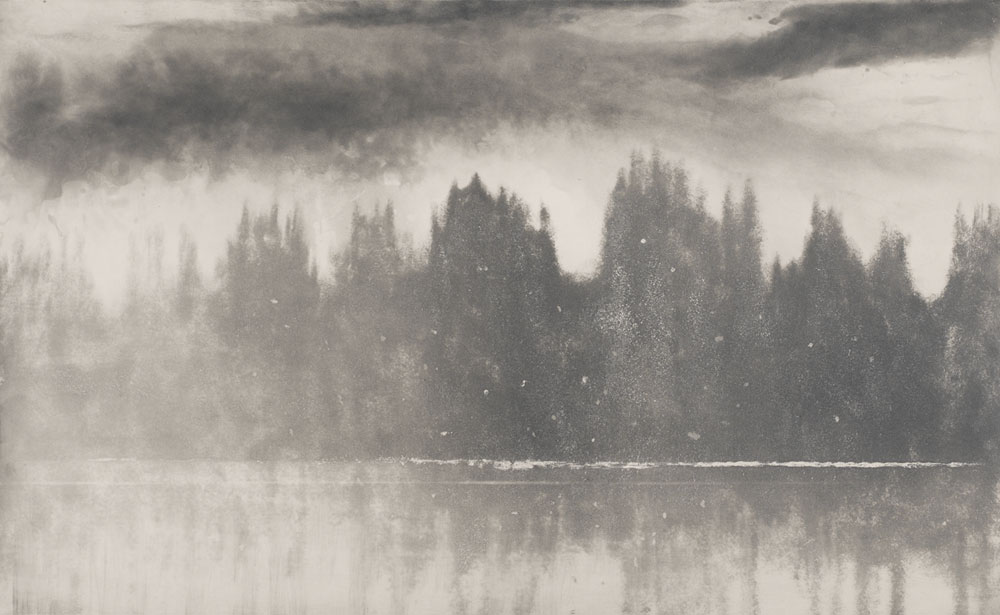
Norman Ackroyd's prints are something else...

The Rumblings Muckle Flugga Shetland - 2013
Loch-Awe-in-Winter-2006
Autumn-Sunrise,-Windermere-1998
Loch-Broom-from-Achiltibuie-(1993)
I love how some of these are just impressions of a shape that suggest a hill or a reflection. They are how, i would say, it feels to look at a landscape. There is something about them that envelopes me when i look at them.

As etchings i am blown away by how smooth they are. Obviously i am have a lot to learn about etchings, when i make etchings they rarely look smooth, you can tell i have used cross hatching and you can sense hoe rough the plate was. But learning different techniques takes time and experimenting.

Comments

Popular posts from this blog

Alice Potter

. Digital Media . Illustration . Surface Pattern . Alice Potter   I decided to start my research with Alice Potter. I was interested in Alice Potter's work because it is very different to what i usually look at.  Potter is a London based freelance illustrator and children's wear print designer. Design is something i am not sure i have an eye for, i do appreciate it but i don't tend to find myself attracted to it, or give it as much thought as i probably should. http://alicepotter.co.uk https://www.etsy.com/uk/shop/AlicePotter I love the colours in this one above, i like how simple it is, but it still translates as an apple. I like the dot print i think it adds a kind of sweetness to the design as well as add something to the flatness of it. I really like these, i love how happy they look because of the use of colour.  Potter draws her work out in her sketch book and then moves onto illustrator where she uses the pen ...

Art & Design Portfolio - Sam Cornwell (Digital)

I decided to start my research on paper based and digital portfolios by first looking at a digital portfolio. One artist who came into the college to do a talk was a photographer called Sam Cornwell, he took us through his digital portfolio. I wanted to think about why his portfolio was digital and not paper based. One of the biggest advantages of a digital portfolio is the accessibility of it. It is easy to send out to employers or people wishing to view it. It is digital so it can easily be send to someone via email or put on a USB and accessed that way. Another reason is unlike a paper based portfolio there is more than one, it is easy to dispatch without spending money on paper to print. It is also instant, you might have to wait a few days for a paper port folio to be sent by mail or spend money on travel to bring it to the person wishing to view it. With a digital portfolio one click and it is sent! I went onto Sam Cornwell's page and found out his portfolio is on his web...

Typography Investagation.

We have started a new unit, typeface and letterforms. I found this very daunting, because, it is a completely new, huge world to me that i have never explored... We watched a film about Helvetica and it was very interesting but like i said i feel really overwhelmed. I wanted to know what happened before more in depth and really look into it as best i could. I decided to calm my nerves by looking into the history of type face, and to, i guess start at the beginning... for myself. while researching i found out that a lot of people agree that the creator of typography was a German man named Johannes Gutenberg. But before he came along books needed to be scribed, by hand. Obviously this was very time consuming, So Guttenberg created Blackletter. I think this was modeled after the scribe's. It has thick vertical lines, and thin horizontal connectors. This was hard for printing, as it looked very dense and squished together. So then came Roman Type, the first roman type was cr...