For photography i wanted to look at artists who use models or staged worlds for their photography because its not something i looked into previous years.
From moodel i came across Rommert Boonstra. He is a photographer, poet and theater director. He also taught photography at several art academies.He is well known for his Staged photography and he has Four books are published about his photo works. He uses everyday objects to create these worlds...


I am pretty taken aback with these photographs and i am surprised there is not a lot about these images online. The only words i can find to describe them is other worldly.
They look like completely different words, like something you would find in science fiction comic. They are just amazing. What i liked about these is the way he has used light and shadows to create the illusion of above and below, in the first 2. He has also used composition and perspective to make you feel like you are inside the world its self.
I like the idea of creating another little world, i think that is why i have always been drawn to collage art.
Then from a different unit i came across an artist called Laurie Simmons.
These images are part of a series called ' Interiors'. In the 70's Simmons started arranging dolls house furniture into these little scenes, she would then photograph them.
“Setting up small rooms with dolls in them was a way for me to experience photography without taking my camera out to the street,” she explained. “I felt that I could set up my own world right around me, without ever having to leave the studio.”
These images were her own replications of domestic scenes from the 1950's, adverts you might see in magazines for the idealize family home, childhood or house wife. Some seem like just dolls set up in different positions. Others, like Blonde/Red Dress/Kitchen seem to be a housewife in the middle of preparing a meal or fixing a bath, or, as if taking a break from her housework, sitting in the living room with the television or newspaper nearby, giving her more of a set character. Simmons describes these as:
From moodel i came across Rommert Boonstra. He is a photographer, poet and theater director. He also taught photography at several art academies.He is well known for his Staged photography and he has Four books are published about his photo works. He uses everyday objects to create these worlds...


I am pretty taken aback with these photographs and i am surprised there is not a lot about these images online. The only words i can find to describe them is other worldly.
They look like completely different words, like something you would find in science fiction comic. They are just amazing. What i liked about these is the way he has used light and shadows to create the illusion of above and below, in the first 2. He has also used composition and perspective to make you feel like you are inside the world its self.
I like the idea of creating another little world, i think that is why i have always been drawn to collage art.
Then from a different unit i came across an artist called Laurie Simmons.
 |
| Woman watching TV 1978 |
 |
| Blonde/ Red Dress/ Kitchen 1978 |
 |
| Purple woman. Gray Chair. Green Rug 1978 |
“Setting up small rooms with dolls in them was a way for me to experience photography without taking my camera out to the street,” she explained. “I felt that I could set up my own world right around me, without ever having to leave the studio.”
These images were her own replications of domestic scenes from the 1950's, adverts you might see in magazines for the idealize family home, childhood or house wife. Some seem like just dolls set up in different positions. Others, like Blonde/Red Dress/Kitchen seem to be a housewife in the middle of preparing a meal or fixing a bath, or, as if taking a break from her housework, sitting in the living room with the television or newspaper nearby, giving her more of a set character. Simmons describes these as:
“a generalized memory of something that seemed sweet and terrifying and abstract and whitewashed.”

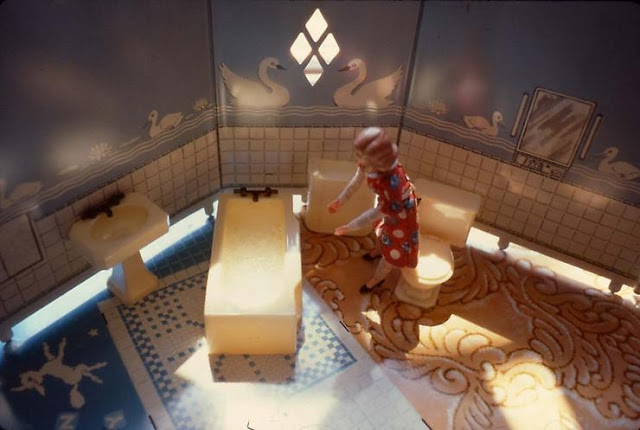

In the rooms, with all the details, the over the top colours and decorations she adds strange people inside them, from people relaxing, partying, having sex to crying. The figures are taken from magazine photographs, sex manuals, cartoons and other printed sources. They have women in black and white and over the top colours and Victorian dressed woman to women from the 90's. They combine drawn figures and photographic images.
They are collaged onto the room renditions; then the whole is photographed. Which i find interesting as photographs, they are photographs or collaged photographs. I like the idea of this having so many layers to it. Which will defiantly be part of my photography.
Sources:
http://www.rommertboonstra.nl/projects/bio/index.htm
http://www.lauriesimmons.net/
https://www.moma.org/learn/moma_learning/laurie-simmons-blondered-dresskitchen-from-the-series-interiors-1978/
https://www.nytimes.com/2004/03/26/arts/art-in-review-laurie-simmons-the-instant-decorator.html
http://www.lauriesimmons.net/photographs/the-instant-decorator?view=slider#11


She also created a series in the early 2000's that is called ' The Instant Decorator'. In this series Simmons was Inspired by a 1976 home makeover manual, ''The Instant Decorator.''
 |
| The instant Decorator Yellow Bathroom 2001 |
 |
| The instant Decorator Yellow Kitchen 2003 |
 |
| The instant Decorator Plad livingroom 2004 |
 |
| The instant Decorator pink, green bedroom slumber party 2004 |
These are brilliant. These collages are the same way as her dolls in that they create these little worlds. I find these almost like a sickly Ikea Advert.
In the rooms, with all the details, the over the top colours and decorations she adds strange people inside them, from people relaxing, partying, having sex to crying. The figures are taken from magazine photographs, sex manuals, cartoons and other printed sources. They have women in black and white and over the top colours and Victorian dressed woman to women from the 90's. They combine drawn figures and photographic images.
They are collaged onto the room renditions; then the whole is photographed. Which i find interesting as photographs, they are photographs or collaged photographs. I like the idea of this having so many layers to it. Which will defiantly be part of my photography.
Sources:
http://www.rommertboonstra.nl/projects/bio/index.htm
http://www.lauriesimmons.net/
https://www.moma.org/learn/moma_learning/laurie-simmons-blondered-dresskitchen-from-the-series-interiors-1978/
https://www.nytimes.com/2004/03/26/arts/art-in-review-laurie-simmons-the-instant-decorator.html
http://www.lauriesimmons.net/photographs/the-instant-decorator?view=slider#11
Comments
Post a Comment